




Quick Answer
Yes. Selling a house with asbestos is legal in both Rhode Island and Massachusetts, and the Rhode Island Department of Health says plainly that state law does not prohibit the sale of a property that contains asbestos. What changes is paperwork and handling: Rhode Island sellers must list known asbestos on the written disclosure, and both states set rules for anyone who removes it.
Key Summary
- Selling a house with asbestos is allowed in Rhode Island and Massachusetts; the material itself does not block a sale.
- Rhode Island’s seller disclosure law names asbestos, and a seller or agent who skips the form can face a civil penalty of up to $1,000 per occurrence.
- Undamaged asbestos is usually safest left alone; EPA, RIDOH and MassDEP all say so.
- Massachusetts requires notice to MassDEP and the Department of Labor Standards at least ten working days before most asbestos removal, with a narrow exemption for some owner-occupied single-family homes.
- A cash sale as-is avoids removal costs and buyer financing problems, but the offer will be below full retail value, so compare it with a listing first.
If an inspector just wrote “possible asbestos” on your report, or you already know the old siding on your house contains it, you are probably wondering whether the sale is in trouble. In most cases it is not. Selling a house with asbestos is common in Rhode Island and southeastern Massachusetts, where a large share of homes were built long before asbestos fell out of use. What you need is a clear picture of what the law asks of you, what buyers and lenders will care about, and which path gets you the best result for your situation.
If your first question is can you sell a house with asbestos at all, the short answer is yes. This guide walks through where asbestos tends to hide in older homes, the disclosure rules in Rhode Island, the removal rules in Massachusetts, and four realistic ways to sell. We also explain when a cash sale makes sense and when it does not. If you are weighing repairs in general, our guide to selling a house that needs repairs covers the bigger picture.
Can You Sell a House With Asbestos in Rhode Island or Massachusetts?
Yes. There is no state rule in either Rhode Island or Massachusetts that stops you from selling a home because it contains asbestos. The Rhode Island Department of Health (RIDOH) states on its asbestos real estate disclosure page that the Rhode Island Asbestos Act does not prohibit the sale of a property that contains asbestos.
The real questions are practical ones. Will you have to disclose it? Will a buyer’s lender or inspector raise concerns? Does anyone need to remove it before closing? The answers depend on where the material is, what condition it is in, and which state the house sits in. Rhode Island and Massachusetts handle this differently, so do not assume a rule from one state applies in the other.
Where Asbestos Shows Up in Older New England Homes
You usually cannot tell whether something contains asbestos by looking at it. The U.S. Environmental Protection Agency says that unless a material is labeled, generally you cannot tell by sight alone, which is why testing by a trained professional matters. EPA’s Learn About Asbestos page lists the household materials most likely to contain it, including:
- Roofing and siding shingles, including asbestos cement shingles
- Attic and wall insulation made with vermiculite
- Vinyl floor tiles, the backing on vinyl sheet flooring, and their adhesives
- Textured paint and patching compounds on walls and ceilings
- Hot water and steam pipes wrapped in asbestos material, blanket or tape
- Oil and coal furnaces and door gaskets with asbestos insulation
- Walls and floors around wood stoves protected with asbestos paper, millboard or cement sheets
Steam heat, oil furnaces and wood stoves are all common in older triple-deckers, capes and colonials across Providence, Pawtucket, Fall River and New Bedford. If your house still has an older heating system, the pipe insulation in the basement is worth having tested before you list.
Asbestos siding
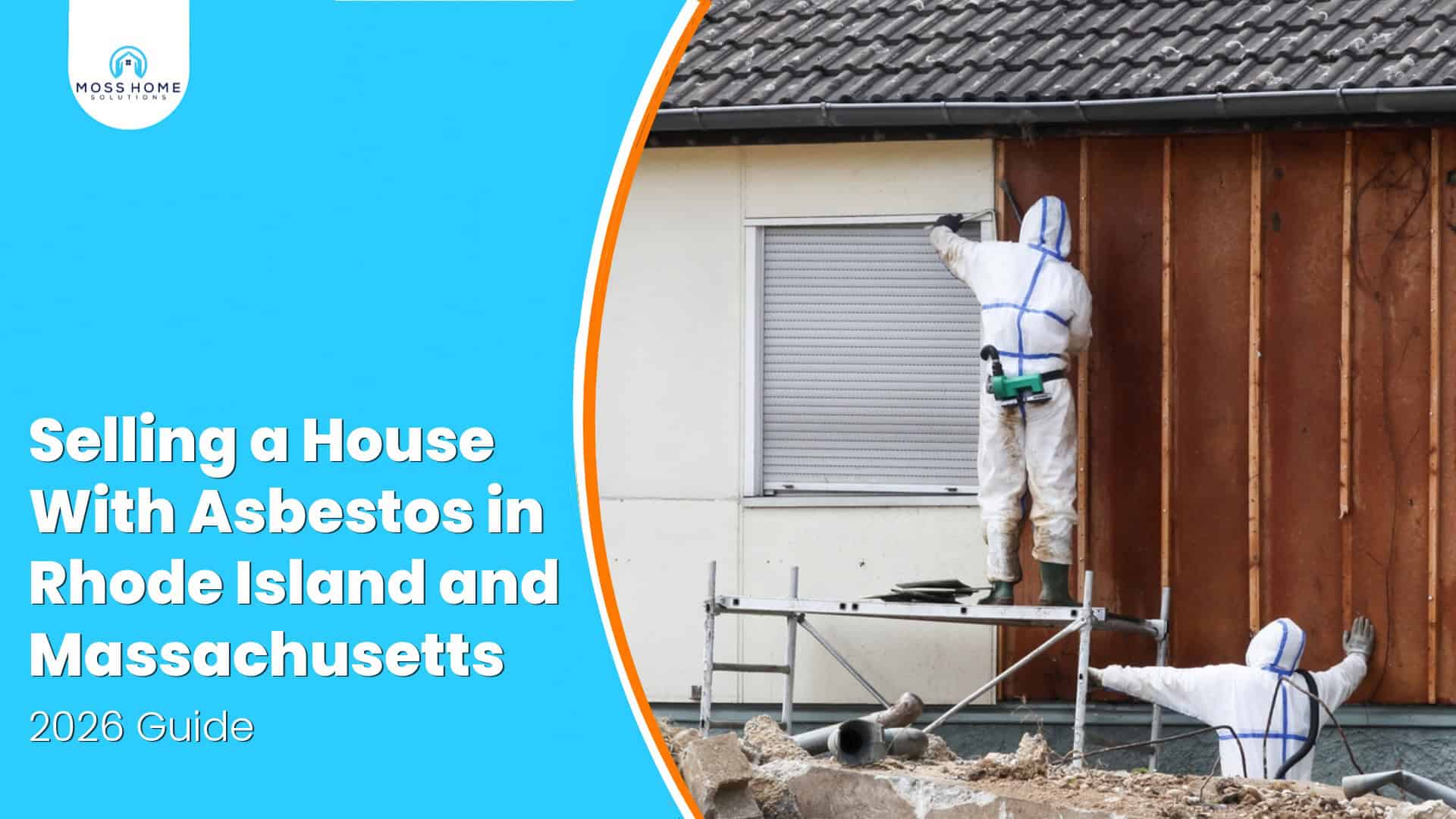
Asbestos siding, often called asbestos cement shingles, is one of the most visible forms buyers notice. EPA’s guidance is to leave undamaged material alone. The concern comes when it is cracked, broken, or cut or drilled during a remodel, because disturbing it can release fibers.
Vermiculite insulation
Vermiculite insulation deserves special attention. According to the EPA’s vermiculite insulation guidance, a mine near Libby, Montana supplied over 70 percent of all vermiculite sold in the United States from 1919 to 1990, often under the Zonolite brand, and it was contaminated with asbestos. EPA tells homeowners to assume vermiculite insulation contains asbestos, not to disturb it, and not to try removing it themselves. It looks like a pebble-like, pour-in product, usually gray-brown or silver-gold.
Is Asbestos Dangerous If You Leave It Alone?
EPA’s advice for homeowners is consistent: leave undamaged asbestos-containing material alone. Its guidance for families explains that exposure generally happens when the material is disturbed or damaged, for example during demolition, maintenance, repair or remodeling. RIDOH’s fact sheet, Don’t Mess With Asbestos, gives the same message and adds clear warnings not to saw, sand, scrape or drill into it, and not to sweep or vacuum debris that may contain it.
The health risks are real. EPA names lung cancer, mesothelioma and asbestosis as the major diseases linked to asbestos exposure, and notes symptoms can take many years to appear. That is exactly why a buyer may react strongly to the word on an inspection report, even when the material is intact and stable.
For a seller, the takeaway is simple. Do not start tearing things out to make the house look better before a sale. That can turn a stable, manageable issue into a hazard, and in Massachusetts it can also put you on the wrong side of the removal rules.
Do You Have to Disclose Asbestos When Selling a House in Rhode Island?
Yes, if you know about it. Rhode Island’s seller disclosure statute, R.I. Gen. Laws section 5-20.8-2, requires sellers to give buyers a written disclosure no later than prior to signing any agreement to transfer the property. It covers all deficient conditions the seller actually knows about, and the form for one to four unit homes includes a line for hazardous waste, with asbestos named.
RIDOH confirms this on its asbestos disclosure page, noting that the disclosure law covers the owner’s knowledge of hazardous materials such as asbestos. Asbestos disclosure in Rhode Island is not optional when you know the material is there.
What happens if a seller skips the form
Under section 5-20.8-5, a seller or seller’s agent who fails to provide the disclosure can face a maximum civil penalty of $1,000 per occurrence. The same section says the failure does not void the agreement or create a defect in title. Even so, hiding a known problem invites disputes after closing, and it is not worth the risk.
Sales that are exempt
Some transfers do not require the disclosure form. Section 5-20.8-3 lists them, including court-ordered transfers such as probate and bankruptcy trustee sales, foreclosure-related transfers, fiduciary transfers from an estate or trust, transfers between co-owners or to a spouse or lineal relatives, and divorce-related transfers between spouses. If you are an executor or trustee, ask your attorney which rules apply to you. Our guide to selling a house with code violations in Rhode Island covers how the same disclosure law treats other known defects.
What Massachusetts Sellers Should Know About Asbestos
Massachusetts treats this differently. The written notice Massachusetts requires from sellers of homes built before 1978 is the Property Transfer Lead Paint Notification, which covers lead paint, not asbestos. Sellers who know about asbestos should still answer a buyer’s questions truthfully and never cover it up, and our guide to what you have to disclose when selling a house in Massachusetts explains how hazardous materials fit into a sale there. For your specific situation, a Massachusetts real estate attorney is the right person to confirm exactly what you must share.
Where Massachusetts gets strict is removal. MassDEP’s asbestos notification guide says anyone planning a project involving asbestos abatement, removal or disposal must notify both MassDEP and the Department of Labor Standards at least ten working days before the work begins.
The homeowner exemption in Massachusetts
The MassDEP regulation, 310 CMR 7.15, has a narrow exemption. An owner of an owner-occupied, single-family residence who does abatement work at that home involving only non-friable asbestos material may be exempt from the notification step, as long as the work does not make the material friable. The exemption does not apply to removing or disturbing more than 100 square feet of exterior asbestos cement shingles, siding and panels. Rental property, multi-family buildings and mixed-use buildings do not qualify. If you are selling an inherited house or a rental, plan on the full rules applying.
Removal Rules in Rhode Island
Rhode Island’s asbestos regulation, 216-RICR-50-15-1, says its licensing and abatement plan requirements do not apply to private residences as the rule defines them. That does not make do-it-yourself removal a good idea. RIDOH’s fact sheet strongly recommends hiring a licensed asbestos professional for a one or two family home, says you must hire one for buildings with three or more apartments or mixed use, and points out that asbestos-containing material is always hazardous waste when it is thrown away.
Disposal has its own limits. RIDOH’s homeowner guidance says the Eco Depot accepts only a small amount of properly bagged, dampened asbestos by appointment. For anything more than a minor repair, a licensed contractor handles the removal, the paperwork and the disposal.
Should You Remove Asbestos Before Selling Your House?
Often, no. When selling a house with asbestos, removal costs money, takes time, and is not required by either state just to complete a sale. Here is how most sellers think it through.
When leaving it in place makes sense
If the material is intact, not crumbling, and not in a spot a buyer will need to renovate right away, leaving it alone and disclosing it is usually the cleanest path, and it lets the buyer plan around it with full information.
When repair or removal makes sense
If material is damaged, such as torn pipe wrap in a finished basement, crumbling insulation, or broken siding, a buyer’s inspector is likely to flag it, and the buyer may ask for it to be addressed before closing. In that case, getting a quote from a licensed contractor before you list gives you real numbers to negotiate with. EPA describes sealing (encapsulation) and covering (enclosure) as alternatives to full removal, and says that work should be done by trained professionals.
What it does to your timeline
In Massachusetts, the ten working day notice period alone adds about two weeks before work can start. Add contractor scheduling and clearance testing, and removal can push a closing date back. If you are on a deadline, factor that in early.
Four Ways to Sell a House With Asbestos
Every situation is different, but most sellers end up choosing one of these four paths.
1. List it as-is and disclose
You leave the material in place, disclose what you know (in Rhode Island, that means the asbestos disclosure line on the seller form), and price the home with the condition in mind. This often gets the highest price if the rest of the house shows well. Our guides to selling as-is in Rhode Island and as-is in Massachusetts walk through how that works.
2. Remove or repair it, then list
You pay a licensed contractor first and market the home as asbestos-free or repaired. This can widen your buyer pool, but you carry the cost and the delay, and there is no guarantee you recover every dollar in the sale price.
3. Offer a credit to the buyer
You get a contractor quote and offer the buyer a price reduction or closing credit so they can handle it after closing. This keeps your timeline intact, though how a credit can be applied depends on the buyer’s loan, so raise it with the buyer’s agent early.
4. Sell to a cash buyer
A cash buyer purchases the house as it stands, with no lender inspection hurdles and no removal before closing. You choose the closing date and skip contractors entirely. The trade-off is price.
How a Cash Sale Works When Selling a House With Asbestos
We want to be straightforward about this. A cash offer for a house with asbestos will be below what the home might bring on the open market after repairs. A cash buyer is taking on the removal cost, the regulatory steps and the risk, and that is built into the number. Our article on what a fair cash offer looks like explains how those offers are calculated so you can judge one on your own.
A cash sale is usually not the best option if the asbestos is limited, intact and the rest of the house is in good shape. In that case, a listing with a clear disclosure will likely net you more. A cash sale tends to make sense when the material is damaged, when there are several other problems on top of it, when the house is vacant or inherited and nobody wants to manage a removal project, or when a lender has already backed out of a deal.
Moss Home Solutions is a local, family-owned company founded by CJ and Beth Moss and based in Seekonk, Massachusetts. We buy houses across Rhode Island and southeastern Massachusetts in as-is condition, including homes with asbestos siding, old pipe insulation and vermiculite insulation. You can read more about us on our About page, and our guide to cash home buyers in Rhode Island covers the checks worth doing on any buyer before you sign.
Frequently Asked Questions About Selling a House With Asbestos
Can you sell a house with asbestos in Rhode Island?
Yes. RIDOH states that the Rhode Island Asbestos Act does not prohibit the sale of a property that contains asbestos. If you know about it, you need to list it on the written seller disclosure required by R.I. Gen. Laws section 5-20.8-2, unless your sale falls under one of the exemptions.
Can you sell a house with asbestos in Massachusetts?
Yes. Massachusetts does not prohibit the sale. The state’s required written notice for older homes covers lead paint, while its asbestos rules focus on removal, which generally requires notice to MassDEP and the Department of Labor Standards at least ten working days in advance.
Do I have to remove asbestos before selling my house?
Usually not. Neither state requires removal just to sell. A buyer may ask for damaged material to be repaired, sealed or removed, which is why a contractor quote helps before you negotiate.
Can I remove asbestos myself before I sell?
It is not recommended. EPA and RIDOH both advise leaving undamaged material alone and using trained, licensed professionals for removal. In Massachusetts, the owner-occupied single-family exemption is narrow and does not cover rentals, multi-family homes or large amounts of exterior asbestos siding.
Does asbestos siding hurt a home’s value?
It can, mostly because some buyers worry about future removal costs. EPA advises leaving undamaged material alone, so intact asbestos siding is usually best left in place, and a clear disclosure plus a contractor quote gives buyers real numbers instead of guesses.
What should I do if I find vermiculite insulation in my attic?
Leave it alone. EPA says to assume vermiculite insulation contains asbestos, not to disturb it, and to hire a professional asbestos contractor if any work would disturb it. Include it in your asbestos disclosure if you are selling in Rhode Island.
Will a cash buyer purchase a house with asbestos?
Many will. Cash buyers like Moss Home Solutions purchase homes in as-is condition, so you do not have to arrange testing or removal first. Expect the offer to reflect the cost of handling the asbestos after closing.
Selling Your Older Home Without the Asbestos Headache
Selling a house with asbestos is mostly about handling it honestly and safely. In Rhode Island, list what you know on the seller disclosure. In Massachusetts, leave removal to licensed professionals who follow the MassDEP and Department of Labor Standards notice rules. In both states, do not disturb intact material, including asbestos siding, just to make the house look better. Then compare your options side by side, including what a listing would likely net after any credits or repairs.
If you would rather skip removal, contractors and repeat inspections, Moss Home Solutions can give you a no-obligation cash offer on your house as it stands. Call us at (401) 395-0600, any day from 8 AM to 8 PM, or request your offer online, and we will tell you plainly whether a cash sale or a listing makes more sense for you.